Lessons

Crash Cushioning Lab - NGSS Based

Profile picture for user Rich
Submitted by Rich on Thu, 12/06/2018 - 16:09

Introduction to Crash Cushioning

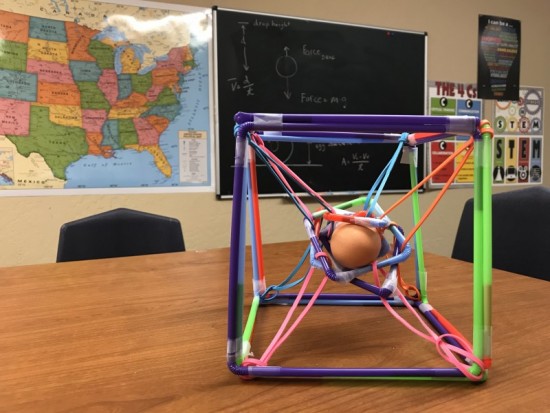
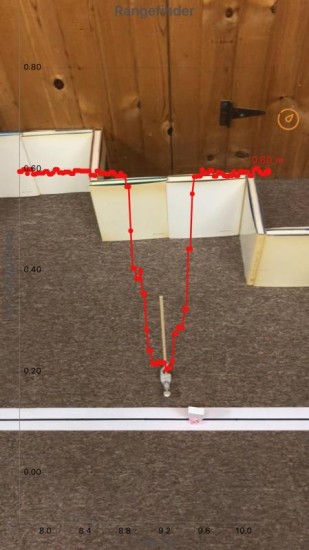
In addition to automobile features that promote road safety, there has been and continues to be a great deal of work on highway features that save lives.  An earlier lab entitled Crash Cushion Investigation, submitted by PocketLab, makes use of the PocketLab HotRod to investigate crash cushioning similar to that shown in Figure 1.    

Theremin Synth Music with Voyager/ScratchX

Profile picture for user Rich
Submitted by Rich on Thu, 08/23/2018 - 15:25

Introduction

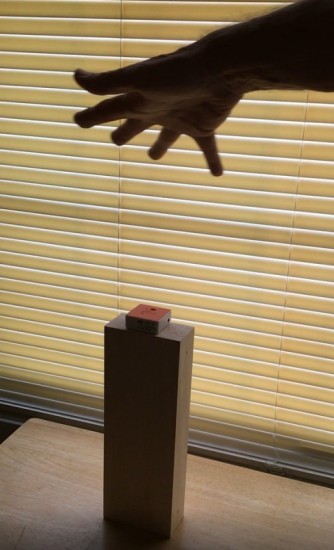
theremin , named after its Russian inventor in the early 1900's, is an electronic musical instrument that is controlled without any contact by the musician.   Volume is controlled by moving one hand near one antenna, while pitch is controlled by moving the other hand near a second antenna.  The sound is generated by a pair of high-frequency oscillators.

Grade Level

PocketLab/Ozobot LIDAR Demonstration

Profile picture for user Rich
Submitted by Rich on Fri, 07/06/2018 - 23:05

Introduction

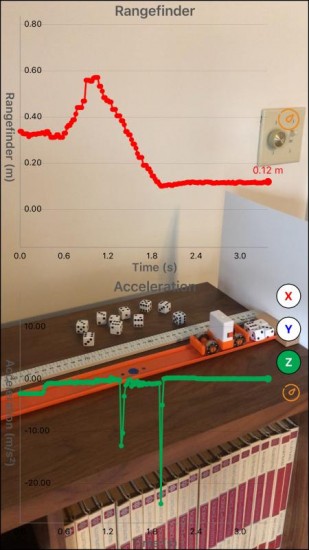
LIDAR—an acronym for Light Detection and Ranging—is a method for remote sensing to measure distances.  While LIDAR commonly uses reflected laser light to accomplish this, students can investigate LIDAR principles by using Voyager’s IR rangefinder in conjunction with Ozobot Evo.  Ozobot is a tiny programmable robot that can follow lines.  In this activity, PocketLab Voyager is mounted on top of Ozobot.  While Ozobot t

Grade Level

Voyager Rides an RC Car for Summertime Fun

Profile picture for user Rich
Submitted by Rich on Wed, 06/20/2018 - 18:18

RC Car Fun!!!

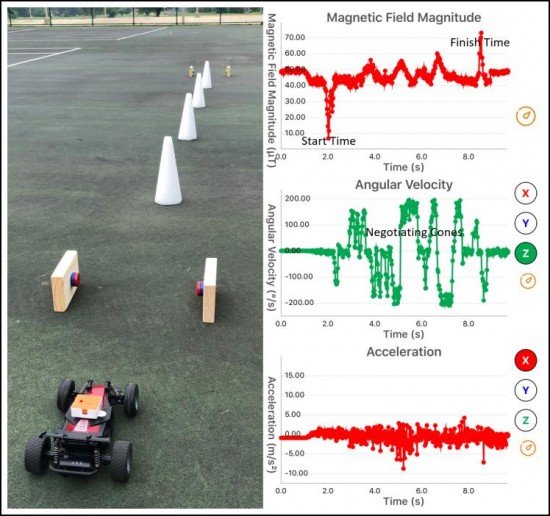
Here is a fun summertime activity!  Race an RC car with PocketLab Voyager. Challenge your friends to see who can negotiate a series of cones in the shortest amount of time without hitting any of the cones.  Start and end times are obtained by Voyager's magnetometer as the RC car passes by magnets.  

Linear Motion - Match the Graph Activity

Profile picture for user PocketLab
Submitted by PocketLab on Mon, 05/07/2018 - 21:52

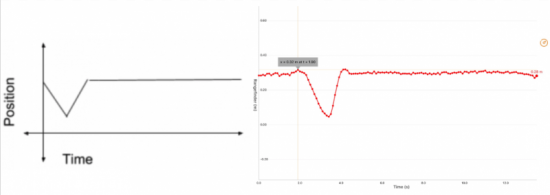
Matching a Graph with Linear Motion

Background Information

In the PocketLab activity Modeling Linear Motion - Position, Velocity versus Time, we learned how graphs can be used to model an object’s motion. In that activity, a cart was pushed up a ramp and PocketLab’s rangefinder measured its change in position and velocity vs. time as it traveled up the ramp, changed direction and came down the ramp. The graphs modeled the cart’s direction of movement and speed.

Grade Level

Modeling Position, Velocity vs. Time

Profile picture for user PocketLab
Submitted by PocketLab on Tue, 05/01/2018 - 19:16

Lab Activity: Modeling Linear Motion with Position and Velocity vs. Time Graphs

Introduction:

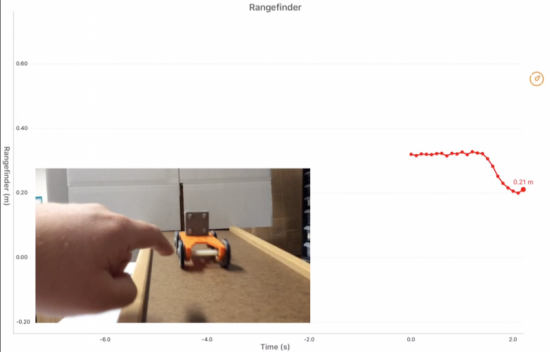
This lab activity helps in understanding how measurements of an object's motion can be modeled in position and velocity vs. time graphs. Velocity is a vector measurement that gives an object’s speed and direction of movement. If a cart is pushed up a ramp, it will experience many changes in velocity that can be observed and measured.

Grade Level

PocketLab HotRod Ramp: A Study in Rotational and Translational Motion

Profile picture for user Rich
Submitted by Rich on Mon, 03/26/2018 - 01:31

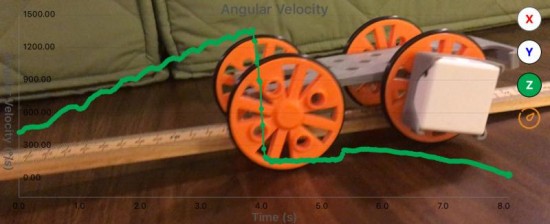
This project will get your physical science/physics students involved in a number of Next Generation Science Standards, particularly in the NGSS science and engineering practices.  This investigation provides a nice opportunity for the students to (1) suggest hypotheses, (2) design an experiment to test their hypotheses, (3) analyze and interpret their data, and (4) use principles of physics to explain their observations quantitatively.

Grade Level

PocketLab Voyager/Wonder Gears: An Experiment on Gear Ratios and Angular Velocity

Profile picture for user Rich
Submitted by Rich on Mon, 03/12/2018 - 03:10

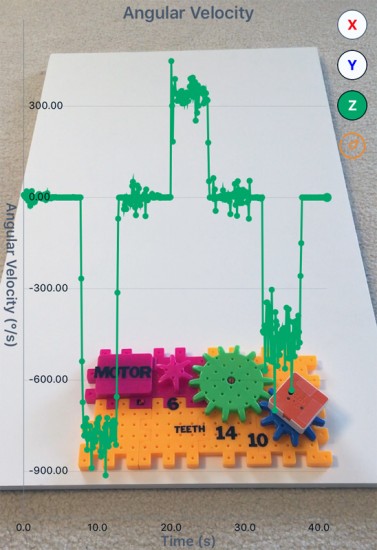
Gears date back many centuries and are extremely useful since they can change the direction imposed by a source of power, as well as torque and speed.  This lesson describes an experimental study of the relationship between gear ratio and angular velocity by using PocketLab Voyager and Wonder Gears.    Wonder Gears is listed for ages 3+, with this lesson heavily emphasizing the “+” part of the description—since this lesson is perfect for junior high students aged 12 through 14.  This is one of the many advantages of Po

Grade Level

To access this free lesson, please sign up to receive communications from us: